What We Like
The best argument for the Bluetti PV200 is straightforward: it gets you into portable 200W-class solar charging at a friendlier price than some better-known alternatives. For homeowners trying to assemble a practical outage kit or pair a panel with a portable power station without overspending, that lower entry price matters. This is still a meaningful solar panel, not a toy-sized accessory, and the savings can be put toward a larger battery, extra cabling, or installation help for the rest of your backup setup.
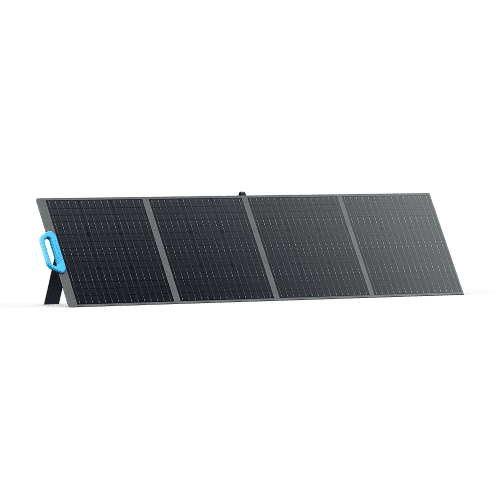
The integrated kickstand is more valuable than it sounds on paper. Portable panels only perform well when they are angled toward the sun with some care, and the PV200 makes that easier than panels that depend on improvised propping. Better angle control usually means more consistent output over the course of the day, and that translates directly into a more useful charging experience for homeowners who are not treating solar setup like a hobby.
Portability is another plus. At roughly 14.5 pounds, the PV200 is manageable for one person to move and deploy, and the folding design makes it realistic to store in a closet, trunk, or garage cabinet. If the panel is easy to grab and set up, you are more likely to use it when needed, which is a real advantage in emergency-preparedness gear.
What Could Be Better
The main caution with the PV200 is compatibility diligence. Bluetti buyers who stay inside the Bluetti ecosystem will usually have the simplest path, but homeowners pairing the panel with another brand's power station need to check connector type, input voltage, and solar-charge limits carefully. Portable solar is not universally plug-and-play across brands, and a cheap adapter is not always enough to make a mismatched combination work correctly.
Bluetti also does not carry the same household-name recognition as brands like Jackery for many mainstream buyers. That does not make the product worse, but it can affect perceived trust, resale confidence, and the ease of finding community troubleshooting advice. Some shoppers will prefer paying a bit more for a brand they already know, especially if they are new to portable energy gear.
Like every foldable panel in this class, the PV200 is still exposed to the usual real-world solar limitations. Output varies sharply with cloud cover, heat, shade, and angle. Buyers who expect rigid-panel consistency from a portable folding panel may be frustrated unless they go in with realistic performance expectations.
Who Is This Best For?
The clearest fit is a budget-conscious buyer who wants dependable solar charging for a power station without paying extra for premium branding. If you already own a Bluetti power station, the PV200 is an especially logical match because compatibility is more straightforward and the setup experience is likely to be smoother.
It is also a good option for homeowners who care about portability more than permanent generation. If your solar use case is emergency charging, camping, tailgating, cabin trips, or keeping a battery topped off during a daytime outage, the PV200 can slot neatly into that role. The panel offers enough size to be useful without becoming so large or awkward that deployment feels like work.
It is less ideal for buyers who want a permanent solar investment or who are uncomfortable checking compatibility details. Those homeowners may be better served by either a more integrated same-brand setup or by an installed home-energy product designed for everyday production rather than mobile charging.
Performance & Efficiency
In field conditions, the Bluetti PV200 lands in much the same practical range as other foldable 200W panels: often about 100W to 160W depending on weather, sun angle, season, and how carefully you position it. The kickstand helps here because it encourages proper panel angle rather than flat-on-the-ground placement, which often leaves easy watts on the table.
For portable power stations, that output band is enough to meaningfully extend runtime or recover a useful chunk of battery over a sunny day. If you are charging a smaller station, the PV200 can feel surprisingly capable. If you are trying to refill a much larger battery from near-empty, expect the process to be measured in many hours or across multiple days, not in quick top-offs.
Efficiency in practice comes down to habit and deployment. Homeowners who reposition the panel once or twice during the day, keep it free of partial shade, and use it during strong sun will get better results than buyers who set it down in a compromised spot and walk away. The PV200 rewards simple, attentive use with solid real-world performance for the price.
Value for Money
At roughly $429 to $499, the PV200 has a strong case as the value-focused alternative to the Jackery SolarSaga 200W. The two panels occupy nearly the same practical use case, and real-world output can be quite similar. For buyers who prioritize lower cost or are already in the Bluetti ecosystem, the PV200 may be the easier recommendation on pure value.
That said, the cheapest panel is not always the best value if it creates extra friction around compatibility or everyday usability. A buyer who wants the simplest same-brand pairing may still prefer a more expensive option if it reduces uncertainty and makes setup easier. Value is not only about sticker price; it is also about how quickly the gear becomes reliably useful in your real routine.
Overall, the PV200 makes sense as a practical, budget-friendly solar companion for portable backup. It does not reinvent the category, but it does offer enough performance, portability, and price discipline to stand out for homeowners who want to keep portable solar costs under control without dropping to a clearly lower tier of capability.